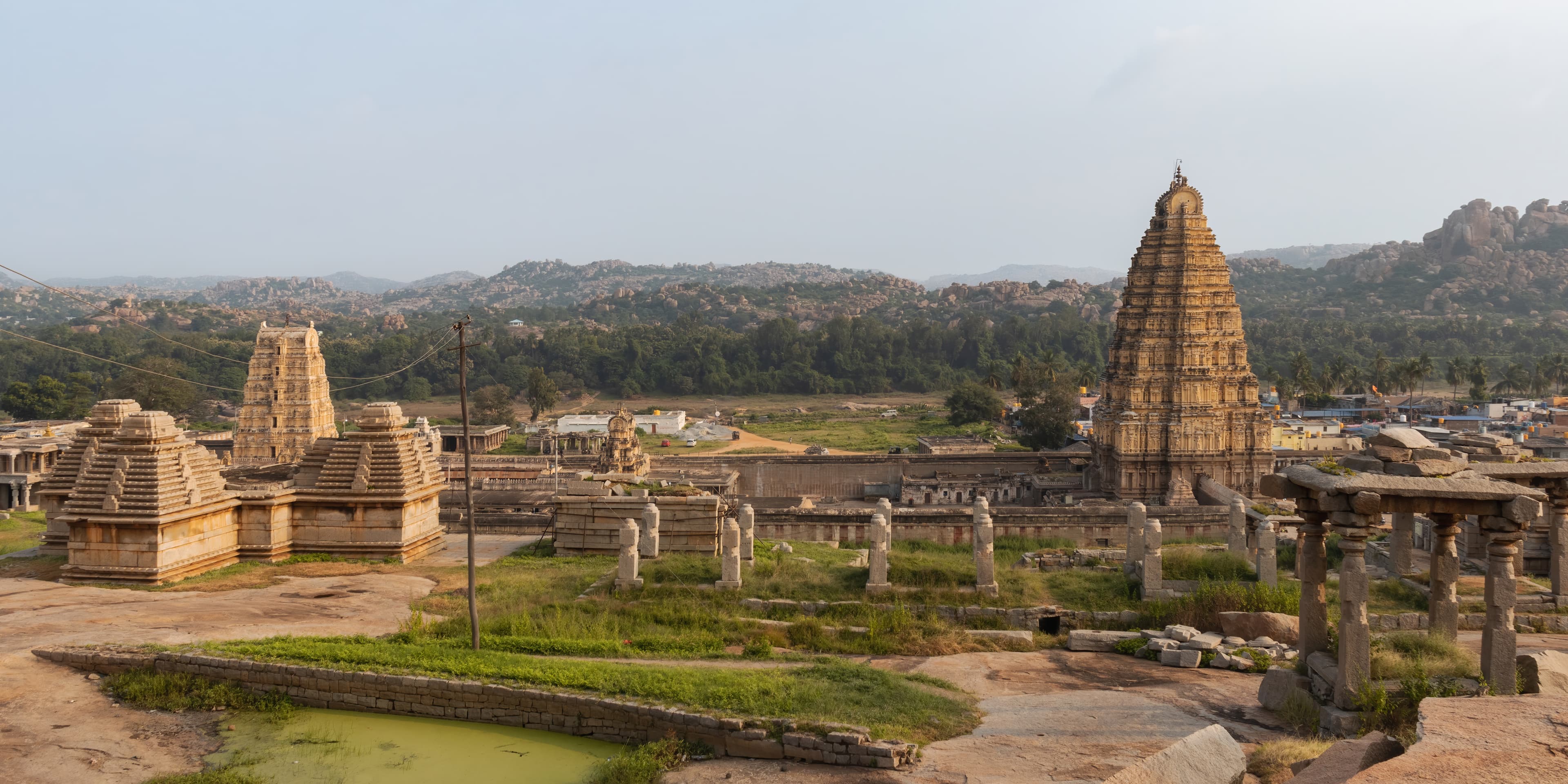
Hampi
The ruined capital of the Vijayanagara Empire (14th-16th century) scattered across a surreal landscape of 500 million-year-old granite boulders in northern Karnataka. UNESCO since 1986. The Virupaksha Temple still functions as an active Hindu shrine; the Vittala Temple's musical pillars and Stone Chariot are the postcard images. The Tungabhadra River divides the bazaar-and-temple side from the Hippie Island (Virupapur Gaddi) backpacker scene. Reached via overnight sleeper bus from Bangalore or Goa.
Tours & Experiences
Browse bookable tours, activities, and day trips in Hampi
📍 Points of Interest
Loading map...
At a Glance
- Pop.
- ~3K (village), 45K (surrounding area)
- Timezone
- Kolkata
- Dial
- +91
- Emergency
- 112
Hampi was once the capital of the Vijayanagara Empire (1336–1565) and the second-largest medieval city in the world after Beijing, with a population estimated at 500,000 at its peak
The ruins spread across 26 km² of surreal granite-boulder landscape in Karnataka — an ancient cityscape scattered among hills of orange and grey boulders worn smooth by millennia of wind
UNESCO inscribed the Group of Monuments at Hampi as a World Heritage Site in 1986, recognising the outstanding Dravidian temple architecture and the dramatic natural setting
The Vijayanagara Empire was sacked and razed in 1565 after the Battle of Talikota by the Deccan Sultanates — the devastation was so complete that Hampi was abandoned almost overnight
Virupaksha Temple in Hampi Bazaar has been continuously active for over 1,000 years and remains a functioning Hindu pilgrimage site today — even as the rest of the city lay in ruin around it
The Tungabhadra River runs along the northern edge of the ruins, and the only way to cross to Hippie Island (Virupapur Gaddi) is by coracle — a round basket boat that has ferried people across these waters for centuries
Top Sights
Virupaksha Temple
📌The spiritual heart of Hampi — a living temple dedicated to Lord Shiva that has been active for over a millennium. Its 50-metre gopuram tower dominates Hampi Bazaar. Elephants bless devotees at the entrance and the inner sanctum glows with oil-lamp light. The oldest continuously functioning monument in the ruins.
Vittala Temple Stone Chariot & Musical Pillars
📌The crown jewel of Vijayanagara architecture — a massive stone chariot with intricately carved wheels sitting before a temple whose pillars, when tapped, produce musical notes. The stone chariot is the image printed on the Indian 50-rupee note. Allow 2–3 hours to absorb the carvings. Entry ₹600 for foreign nationals.
Royal Centre — Lotus Mahal & Elephant Stables
🗼The Royal Centre holds the most elaborate secular architecture in the ruins. The Lotus Mahal is a two-storey pavilion of delicate Indo-Islamic arches that supposedly served as the queen's palace. Directly nearby, the Elephant Stables — eleven domed chambers that once housed the royal war elephants — are among the finest examples of medieval elephant architecture anywhere in India.
Hemakuta Hill at Sunset
📌A low hill south of Virupaksha Temple covered in pre-Vijayanagara Jain and Hindu temples. At sunset, the granite boulders glow amber and the silhouettes of the gopurams and the Tungabhadra below create one of the most photographed tableaux in South India. Arrive 30 minutes before sundown to claim a rock.
Matanga Hill at Sunrise
📌The highest point in Hampi, reached by a steep staircase of 500+ steps through boulder fields beginning before dawn. At the summit, the entire ruin field spreads in every direction below a sky that turns from black to gold. The most rewarding sunrise view in Karnataka — and genuinely earned. Wear shoes with grip and bring a torch.
Anjanadri Hill
📌A 575-step climb up a sacred hill believed to be the birthplace of Hanuman, the monkey god of the Ramayana. The hilltop temple commands sweeping views over the river and boulder-strewn plains. The journey up passes wild monkeys (keep food hidden), resident sadhus, and devotees who make the climb barefoot as an act of faith.
Hippie Island — Virupapur Gaddi
📌Cross the Tungabhadra by coracle (₹50 per person) to reach this laid-back strip of guesthouses, paddy fields, and banana plantations on the north bank. Known by backpackers as Hippie Island, it offers hammocks, rice-field walks, yoga shacks, and a pace completely at odds with the archaeological intensity across the river. The atmosphere is relaxed and the sunsets are superb.
Off the Beaten Path
Anegundi Village
The ancient village across the river from Hampi, older than the Vijayanagara Empire itself and believed to be the Kishkindha of the Ramayana. Quieter than Hampi village, with local guesthouses, banana plantations, a heritage craft initiative, and fewer tourists. Anegundi is the base for hiking Anjanadri Hill.
Most visitors never cross to this side. Anegundi's craft cooperative produces beautiful hand-loom textiles using traditional Karnataka methods — the only authentic local souvenir in the area.
Coracle Crossing at Dawn
The round wicker-and-tar coracle boats that cross the Tungabhadra have been used here for centuries. The crossing at dawn — before the tour buses arrive, with the boulders turning pink and kingfishers darting low over the water — is one of Hampi's most peaceful experiences.
At ₹50 per person, it is the best-value moment in Hampi. Photograph from the coracle as the boatman spins to correct direction; the ancient ghats and boulders make an otherworldly backdrop.
Queen's Bath
An ornate open-air bathing pavilion inside the Royal Centre complex, surrounded by a moat and decorated with stucco carvings of lotus and fish. Once filled via perfumed aqueducts, it now sits silent among the ruins — a meditative spot that most visitors bypass on their way to Lotus Mahal.
The acoustics inside the arched corridors are remarkable and the structure is almost always quiet. Early morning light falls beautifully through the open ceiling onto the sunken pool.
Sule Bazaar & Achyutaraya Temple
A long colonnade of ruined market stalls leading to the Achyutaraya Temple — one of the best-preserved and most atmospheric temple complexes in the entire site. The enclosure walls are still nearly complete and the main mandapa carvings are exceptional. Rarely crowded compared to Vittala.
This temple complex sees a fraction of the visitors that Vittala attracts, but the scale and detail of the stone carving is comparable. The ruined bazaar street leading to it is one of the most evocative walks in Hampi.
Tungabhadra River Walk at Dusk
Following the riverbank path east from Virupaksha Temple toward Vittala as the sun sets, passing ghats where sadhus meditate, coracles being pulled ashore, and boulders that glow orange then red. The 3 km walk along the river offers constantly changing compositions of ruins, water, and rock.
No entrance fee, no crowds, no organised tour includes it. The ghat steps are ancient, some carved with inscriptions in Kannada. Wild otters occasionally appear in the shallows at dusk — a genuine surprise in the middle of a UNESCO ruin field.
Insider Tips
Climate & Best Time to Go
Monthly climate & crowd levels
Hampi sits on the Deccan Plateau in northern Karnataka, giving it a semi-arid climate with extremes in both directions. The tourist season runs mid-October to mid-March, when temperatures are pleasant and the granite ruins are comfortable to explore on foot. The remaining months — summer heat peaking above 40°C and a monsoon that turns paths muddy — make off-season visits genuinely challenging.
Winter (Peak Season)
November - February64-86°F
18-30°C
The best time to visit. Days are warm and sunny, nights pleasantly cool. Skies are clear blue and the granite boulders glow gold in the low winter light. December and January are peak tourist months — book accommodation ahead.
Hot Season
March - May95-108°F
35-42°C
Increasingly brutal heat builds from March onward. By April and May, the Deccan is a furnace. Exploring the open ruin fields between 10 am and 4 pm is genuinely dangerous without constant water and shade breaks. Not recommended for first-time visitors.
Monsoon
June - September72-90°F
22-32°C
The South-West Monsoon brings heavy rain to the Deccan from June through September. The landscape turns vividly green and the boulder hillsides bloom with wildflowers. Paths become slippery, coracle crossings are suspended during high water, and some sites flood briefly. A quiet, unusual time to visit for the adventurous.
Shoulder — Green Season
October72-91°F
22-33°C
Monsoon recedes and the landscape is still lush green from the rains, creating a striking contrast with the orange granite. Fewer tourists than the peak winter months. Occasional leftover showers. A lovely time to visit if you book early for the Hampi Utsav festival.
Best Time to Visit
November through February is the clear peak season — cool, dry, and manageable for hours of outdoor ruin exploration. October is beautiful and less crowded, with the landscape still green from the monsoon. Avoid April and May when Deccan temperatures exceed 42°C in the open ruin fields.
Winter — Peak Season (November - February)
Crowds: High in December–January; moderate in November and FebruaryThe best months to visit. Temperatures are pleasant (18–30°C), skies are cloudless, and the granite boulders glow gold in the low winter sun. December–January is peak; book accommodation early. Hampi Utsav festival in November draws large crowds.
Pros
- + Comfortable temperatures for walking ruins all day
- + Clear skies for photography
- + All coracle crossings running
- + Hampi Utsav festival in November
Cons
- − December–January accommodation fills weeks in advance
- − Prices at their highest
- − Busier temple sites and more competition for sunrise spots
Shoulder — Green Season (October)
Crowds: Low to moderateThe monsoon has just departed. The boulder landscape is still lush and green, creating an unusual colour contrast with the orange granite. Occasional showers possible. Fewer tourists than peak season and lower prices.
Pros
- + Green landscape unlike any other time of year
- + Lower prices and easy to find accommodation
- + Diwali festival in October or November
- + Pleasant temperatures
Cons
- − Risk of late monsoon rain
- − Some paths still muddy
- − River crossings may be restricted early in the month
Hot Season (March - May)
Crowds: Very lowTemperatures climb sharply from March, hitting 35–42°C by April and May. The ruins are intensely hot on exposed ground. Very few international tourists; some budget backpackers stay for the solitude. Only feasible with very early morning starts (6–9 am) and late afternoon visits.
Pros
- + Cheapest prices of the year
- + Ruins almost entirely to yourself
- + No need to book ahead
Cons
- − Genuinely dangerous heat between 10 am and 4 pm
- − Heatstroke risk without careful precautions
- − Unpleasant for extensive outdoor exploration
Monsoon (June - September)
Crowds: Very low — mainly domestic pilgrimsHeavy rainfall on the Deccan Plateau. The ruins take on an otherworldly quality when the granite boulders are dark with rain and the surrounding hills turn vivid green. Coracle crossings may be suspended during high water. For adventurous travellers comfortable with rain, it is a hauntingly beautiful time.
Pros
- + Dramatically lush and photogenic
- + Almost no tourists
- + Lowest prices
- + Cool relief after the hot season
Cons
- − Heavy rain makes ruin paths slippery and sometimes impassable
- − River crossings suspended during peak monsoon
- − Leeches on wooded paths
- − Some guesthouses close for the season
🎉 Festivals & Events
Hampi Utsav
November (first weekend)A three-day state-sponsored cultural festival with classical dance, music, puppet shows, and illuminated monument tours. The ruins are lit up at night and the town fills with performers and visitors from across Karnataka.
Virupaksha Car Festival
March / April (Shivaratri period)The most important religious event in Hampi — a massive wooden chariot carrying the deity of Virupaksha Temple is pulled through Hampi Bazaar by thousands of devotees. One of the most vivid temple chariot festivals in South India.
Diwali
October / NovemberThe Festival of Lights transforms Hampi village and Hospet with oil lamps, firecrackers, and family celebrations. The Virupaksha Temple is lit with thousands of oil lamps — an extraordinary sight against the dark boulder landscape.
Safety Breakdown
Moderate
out of 100
Hampi is a safe destination by Indian standards, with violent crime toward tourists extremely rare. The primary hazards are environmental rather than human — heat stroke in summer, slippery barefoot temple steps, and monkey bites from the large Rhesus macaque population around the temples. India's overall safety index sits around 112 on global peace indices; Hampi, as a pilgrimage and tourist town, is notably calmer than urban India.
Things to Know
- •Carry 2–3 litres of water when exploring ruin sites — there are no shops between monuments and heat stroke is a real risk even in winter
- •Remove shoes before entering any active temple (Virupaksha, Anjanadri, hilltop shrines) — the stone can be scalding in midday sun; visit before 9 am or after 4 pm
- •Do not feed or make eye contact with the macaque monkeys around Virupaksha Temple — they will snatch food from bags and bites require immediate rabies prophylaxis
- •The boulders that look climbable often have unexpectedly loose footing — stay on marked paths and wear shoes with grip on the hillside climbs
- •Hampi Bazaar has no ATMs — withdraw all cash needed from Hospet before arriving, as the nearest functioning ATMs are 13 km away
- •No alcohol is sold or served in Hampi village or the Sacred Centre zone — if you want a beer, cross to Hippie Island or return to Hospet
- •Negotiate auto-rickshaw fares firmly before departing — agree on a full-day rate upfront rather than per-monument to avoid disputes mid-tour
- •Dress modestly when entering active temples — shoulders and knees should be covered; scarves sold at the temple entrance are inexpensive
Natural Hazards
Emergency Numbers
Police (national)
100
Ambulance
108
Fire
101
Tourist Helpline
1363
Women's Helpline
1091
Costs & Currency
Where the money goes
USD per dayQuick cost estimate
Customize per category →Estimates based on regional averages. Flight prices vary by season and airline.
budget
$15-25
Hampi village guesthouse or Hippie Island bamboo hut, thali meals, bicycle rental, self-guided ruin exploration
mid-range
$40-70
Mid-range hotel in Hospet or comfortable guesthouse, restaurant meals, scooter or auto, licensed guide for a day
luxury
$100+
Boutique heritage property outside the restricted zone, private guide and vehicle, good restaurants in Hospet
Typical Costs
| Item | Local | USD |
|---|---|---|
| AccommodationHampi village guesthouse (basic double) | ₹500–1,200 | $6–14 |
| AccommodationHippie Island bamboo hut (Virupapur Gaddi) | ₹400–800 | $4.80–9.60 |
| AccommodationMid-range hotel in Hospet (AC double) | ₹2,000–4,000 | $24–48 |
| FoodVeg thali at local restaurant | ₹100–200 | $1.20–2.40 |
| FoodBanana pancake / traveller cafe meal | ₹150–300 | $1.80–3.60 |
| FoodFilter coffee | ₹20–50 | $0.24–0.60 |
| TransportBicycle rental (full day) | ₹100–150 | $1.20–1.80 |
| TransportScooter rental (full day) | ₹250–400 | $3–4.80 |
| TransportAuto-rickshaw (full day, bargained) | ₹800–1,000 | $9.60–12 |
| TransportCoracle river crossing | ₹50 | $0.60 |
| AttractionsArchaeological Zone entry (foreigners) | ₹600 | $7.20 |
| AttractionsLicensed English-speaking guide (per day) | ₹500–1,500 | $6–18 |
💡 Money-Saving Tips
- •The ₹600 archaeological zone ticket covers both Vittala and the Royal Centre — buy it once and keep it; inspectors may check
- •Eat at the small restaurants on the lanes behind Virupaksha Temple — thalis for ₹100–150, half the price of guesthouse menus
- •Stay on Hippie Island rather than Hampi village for consistently lower guesthouse prices and a more relaxed vibe
- •A bicycle covers the Sacred Centre loop for ₹100–150/day — more than sufficient for most of the key monuments
- •Hospet has a night market and dhaba strip near the bus stand where locals eat — ₹80–120 for a full meal
- •Matanga Hill and Hemakuta Hill viewpoints are free — the most spectacular views in Hampi cost nothing
- •Book overnight trains (Hampi Express) on IRCTC well ahead — sleeper class at ₹250–350 is excellent value for the Bangalore connection
- •Visit the free ghats and riverside walk in the late afternoon — one of Hampi's most atmospheric experiences at zero cost
Indian Rupee
Code: INR
1 USD is approximately ₹83–85 (as of early 2026). CRITICAL: There are no ATMs in Hampi village. The nearest ATMs are in Hospet, 13 km away — State Bank of India, Canara Bank, and HDFC all have branches there. Withdraw enough cash for your entire Hampi stay before arriving. Most guesthouses, restaurants, and all temple stalls are cash-only. UPI payments (Google Pay, PhonePe) work at some larger guesthouses.
Payment Methods
Cash is essential everywhere in Hampi. Withdraw sufficient INR from Hospet ATMs before arriving — plan for your entire stay plus a buffer. A growing number of guesthouses accept UPI via QR code; international cards with Google Pay or Apple Pay linked to UPI may work. Credit cards are generally not accepted in Hampi village or on Hippie Island. A few Hospet hotels accept cards with a surcharge.
Tipping Guide
Tipping is appreciated but not mandatory in budget dhabas. In sit-down restaurants, 10% of the bill is appropriate. Round up to the nearest ₹50 in casual places.
₹500–1,500 per day depending on English fluency and knowledge depth. Agree on a total before starting. Tip at the end of the day in cash.
Tipping is not customary if you negotiated a fair rate upfront. For excellent service or a helpful driver-guide, ₹50–100 extra at the end of the day is appreciated.
No fixed expectation. For stays of 3+ nights, ₹100–200 left for cleaning staff is generous and meaningful at local wage levels.
The ₹50 fare is fixed. A ₹10–20 extra tip for a good crossing or help with luggage is always welcomed.
How to Get There
✈️ Airports
Hubli Airport(HBX)
165 km westTaxi from Hubli to Hampi takes approximately 3 hours (₹2,500–3,500). Hubli has connections from Bangalore, Hyderabad, and Mumbai. Alternatively, take a bus or taxi from Hubli to Hospet (2.5 hr, ₹200–400 shared bus) and a prepaid auto from Hospet to Hampi (₹250–400).
✈️ Search flights to HBXKempegowda International Airport, Bangalore(BLR)
350 km southOvernight bus from Bangalore Majestic bus station direct to Hampi/Hospet (7–8 hr, ₹400–700). Alternatively, Bangalore to Hospet Junction by train (Hampi Express 16591, departs ~22:00, arrives ~06:00, ₹250–800 depending on class). From Hospet, prepaid auto-rickshaw to Hampi takes 25–30 min and costs ₹250–400.
✈️ Search flights to BLR🚆 Rail Stations
Hospet Junction (HPT)
The railhead for Hampi, 13 km away. Key services: Hampi Express 16591 from Bangalore (overnight, ~8 hr); Goa connections via Hubballi require a change. From Hospet station, prepaid auto-rickshaws to Hampi cost ₹250–400 and take 25–30 minutes. State buses also run hourly (₹20–30, 45 min). Book train tickets on IRCTC well in advance — the overnight Hampi Express sells out fast in peak season.
🚌 Bus Terminals
Hospet KSRTC Bus Stand
Karnataka State Road Transport Corporation (KSRTC) runs overnight buses from Bangalore (7–8 hr, ₹400–700) and day buses from Hubli (3 hr, ₹150–250). Private sleeper buses from Goa (9–10 hr, ₹700–1,200) drop at Hospet. Local buses from Hospet to Hampi Bazaar run every 30–45 minutes (₹20–30, 45 min).
Getting Around
Hampi's ruins span roughly 26 km² — too large to walk entirely but well-suited to bicycle or scooter. The Sacred Centre (Virupaksha to Vittala Temple, ~3 km) can be done on foot. The Royal Centre (Lotus Mahal, Elephant Stables, Queen's Bath) is a further 3–4 km south, making a bicycle or hired auto-rickshaw the practical choice for covering both zones in a day.
Rented Bicycle
₹100–150/day (~$1.20–1.80)The classic Hampi experience — simple single-speed cycles rented from guesthouses and small shops along Hampi Bazaar. Flat enough on the main ruin roads, though the path to Vittala Temple is sandy and challenging in places. Suitable for the Sacred Centre loop.
Best for: Sacred Centre exploration, casual ruin hopping, budget travellers
Rented Scooter
₹250–400/day (~$3–4.80)Scooters (usually Honda Activa) allow you to cover both the Sacred and Royal Centres comfortably in a day and reach outlying temples beyond the main sites. Rental shops in Hampi Bazaar and on Hippie Island. International licence recommended; Indian police occasionally check documents.
Best for: Covering both Sacred and Royal Centres, outlying temples, Anegundi village
Auto-Rickshaw (Bargained)
₹500–700 half-day; ₹800–1,000 full day (~$6–12)Three-wheelers available for hire in Hampi Bazaar and at Hospet. Negotiate a half-day or full-day rate to avoid per-stop disputes. Drivers often double as informal guides with genuine local knowledge — worth the conversation.
Best for: Families, those avoiding heat, covering maximum sites efficiently
Walking
FreeThe only option within temple precincts and on the boulder hillside trails (Matanga Hill, Hemakuta Hill). The Sacred Centre arc — Virupaksha, Hemakuta Hill, Sule Bazaar, Achyutaraya Temple — is walkable in a half-day. Comfortable shoes essential; sandals alone are inadequate on boulder paths.
Best for: Temple interiors, sunrise/sunset hikes, Sacred Centre heritage walk
Coracle (River Crossing)
₹50 per person (~$0.60)Round basket-and-tar boats manually propelled by a boatman, used to cross the Tungabhadra between Hampi and Hippie Island (Virupapur Gaddi) or Anegundi. Suspended during high monsoon water. An unforgettable few minutes on the river.
Best for: Reaching Hippie Island, Anegundi village, Anjanadri Hill
🚶 Walkability
The Sacred Centre core is walkable but the full ruin field is not — distances between major sites range from 1 to 6 km on sandy or rocky paths. The Royal Centre is not comfortably walkable from Hampi village. A bicycle is the minimum recommended transport for visitors wanting to cover both zones.
Travel Connections

Goa
India's famous coastal state — beaches, seafood, Portuguese-colonial architecture, and a nightlife scene that runs all night. The overnight Hampi Express to Madgaon (Goa) is one of the great budget train journeys in India, dropping you at the coast by morning.

Bangalore
Karnataka's capital and India's tech hub — a cosmopolitan city with excellent restaurants, craft-beer bars, colonial-era Lalbagh gardens, and good international flight connections for onward travel.

Badami Caves
A dramatically situated town where 6th-century Chalukya rock-cut cave temples are carved into a red sandstone cliff above a sacred tank. Often overlooked by Hampi visitors, Badami offers a quieter but architecturally rich day trip or overnight extension.

Mysore
The City of Palaces — home to the luminously lit Mysore Palace, silk saree workshops, Chamundi Hill temple, and the famous Dasara festival in October. A softer, more regal counterpoint to the raw power of Hampi's ruins.
Entry Requirements
Most nationalities require a visa to enter India. The e-Visa system (Tourist eVisa) covers the vast majority of visitors and is applied for entirely online before travel. Entry to Hampi itself is unrestricted once in India — no additional permits are required for the archaeological sites beyond the entry ticket.
Entry Requirements by Nationality
| Nationality | Visa Required | Max Stay | Notes |
|---|---|---|---|
| US Citizens | Yes | 60 days (double/multiple entry available) | Apply for Tourist eVisa online at indianvisaonline.gov.in at least 4 days before travel. Must enter through designated airports — Bangalore (BLR) is the closest for Hampi. |
| UK Citizens | Yes | 60 days | Tourist eVisa available online. Apply minimum 4 days before arrival. UK passport holders with Indian-origin documentation may qualify for OCI card (lifetime visa). |
| EU Citizens | Yes | 60 days | All EU nationals require a Tourist eVisa. Apply online at indianvisaonline.gov.in. Most applications approved within 72 hours. |
| Australian Citizens | Yes | 60 days | Tourist eVisa available online. Apply at least 4–5 days before travel. Ensure passport has at least 6 months validity and two blank pages. |
| Canadian Citizens | Yes | 60 days | Tourist eVisa via the standard online portal. Single, double, and 5-year multiple-entry options available at different costs. |
| Japanese Citizens | Yes | 60 days | Tourist eVisa available. Japan is eligible for the standard e-Visa. Apply online at least 4 days ahead. |
Tips
- •Apply for the eVisa at least 5–7 days before travel — processing is usually 72 hours but delays occur around Indian public holidays
- •Print your eVisa approval or save it offline — immigration officers at Bangalore airport will check it on arrival
- •Your eVisa is linked to a specific port of entry — ensure you are flying into one of the designated airports (Bangalore BLR for Hampi)
- •Carry photocopies of your passport and visa approval when exploring ruins — keep originals locked at your guesthouse
- •The ₹600 archaeological entry ticket for Hampi's protected monuments is mandatory for all foreign nationals — carry the receipt
Shopping
Shopping in Hampi is deliberately limited — Hampi Bazaar, the historic market street in front of Virupaksha Temple, was officially shut down and cleared by the Archaeological Survey of India in 2011 to restore the monument's heritage zone. A small number of craft stalls operate near the temple entrance. Serious shopping requires the 13 km trip to Hospet or a visit to Anegundi village across the river.
Virupaksha Temple Stalls
temple marketA small cluster of stalls along the entrance of Virupaksha Temple selling religious items, rudraksha beads, postcards, basic souvenirs, and Karnataka coffee and spices. Prices are fixed and modest.
Known for: Rudraksha malas, Virupaksha brass idols, Karnataka filter coffee powder, temple prasad
Anegundi Village Crafts (Kishkinda Trust)
craft cooperativeThe Kishkinda Trust in Anegundi village operates a craft initiative producing hand-loom fabrics, banana-fibre products, and handmade paper using traditional methods. Buy directly from artisans at the trust workshop. A meaningful alternative to mass-produced souvenirs.
Known for: Hand-loom Karnataka cotton scarves, banana-fibre bags and baskets, handmade paper journals, block-printed textiles
Hospet Markets
town marketHospet has a functioning commercial town centre with ATMs, pharmacies, clothing shops, and a daily produce market. The best place to stock up on Karnataka spices, local jaggery, and practical supplies for extended stays in Hampi.
Known for: Karnataka spices, jaggery, local coffee, practical supplies, clothing and footwear
🎁 Unique Souvenirs to Look For
- •Sandstone or brass replicas of the Vittala stone chariot — available from temple stalls and Hospet shops
- •Hand-loom cotton scarves and fabric from the Kishkinda Trust cooperative in Anegundi
- •Banana-fibre baskets and bags — a sustainable craft tradition from Anegundi village
- •Karnataka filter coffee powder — among the best in India, available in Hospet supermarkets and temple stalls
- •Handmade paper journals from the Anegundi craft workshop
- •Rudraksha mala (prayer beads) from temple stalls outside Virupaksha — blessed by temple priests
- •Postcards of the ruins — still the most honest souvenir given the photogenic landscape
Language & Phrases
Kannada is the official language of Karnataka and is spoken by most locals in Hampi and Hospet. Hindi is understood by many, especially in the tourist trade. English is widely spoken by guesthouse owners, guides, and younger residents in tourist areas. A few Kannada words go a very long way — locals are visibly delighted when foreign visitors attempt the language.
| English | Translation | Pronunciation |
|---|---|---|
| Hello / Greetings | Namaskara | nah-mah-SKAH-rah |
| Thank you | Dhanyavaada | dahn-yah-VAH-dah |
| Yes | Howdu | HOW-doo |
| No | Illa | ILL-ah |
| How much? | Yeshtu? | YESH-too? |
| Too expensive! | Thumba daadu! | TOOM-bah DAH-doo! |
| Where is...? | ... elli ide? | ... EL-lee EE-day? |
| Water | Neeru | NEE-roo |
| Food / Rice | Anna | AH-nah |
| Good / Beautiful | Chenna | CHEN-nah |
| Excuse me / Sorry | Kshamisi | kshah-MEE-see |
| God willing (widely understood) | Insha'Allah / Bhagavana ichhe | in-SHAH-ah-LAH / bah-gah-VAH-nah ICH-hay |