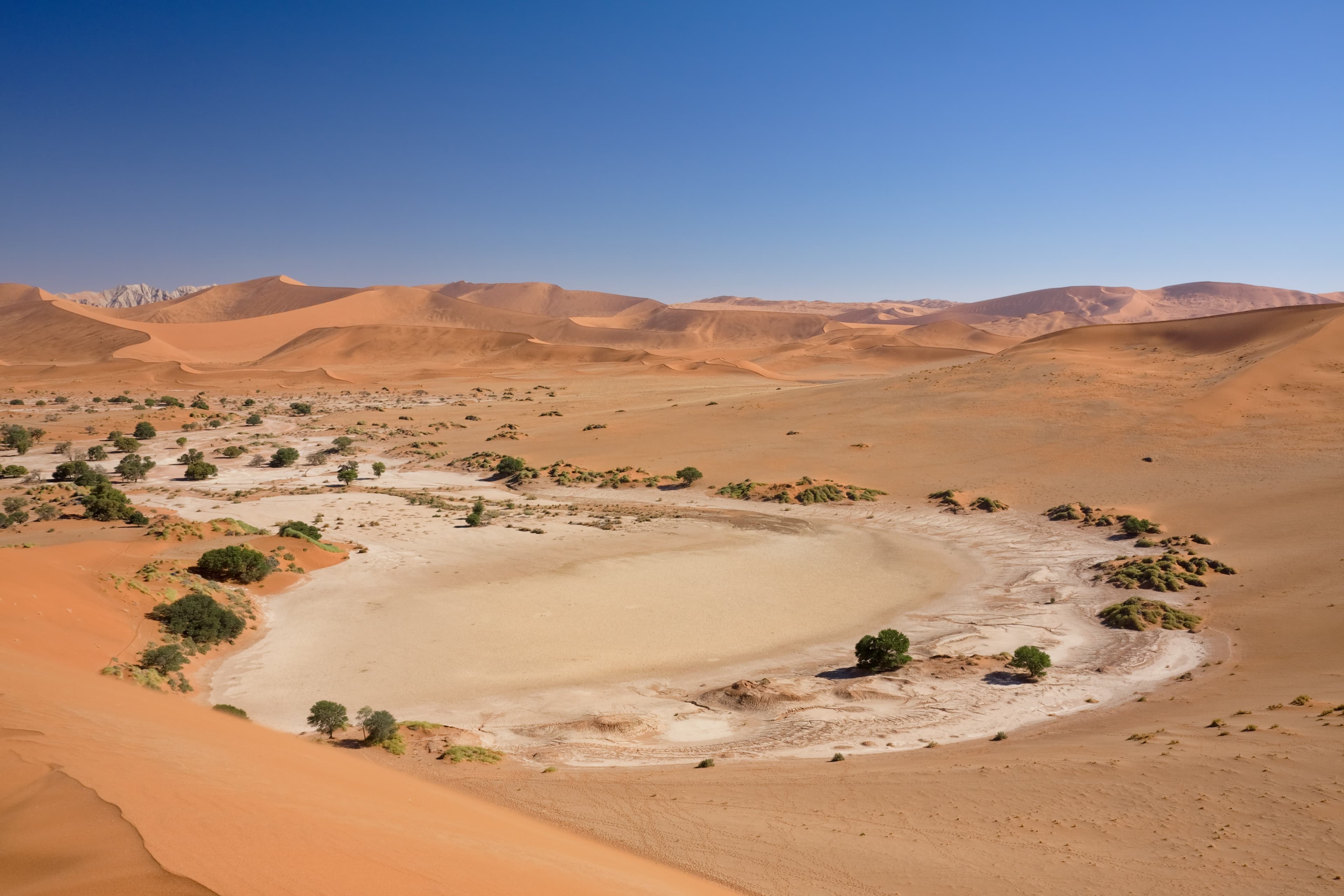
Sossusvlei
A salt-and-clay pan deep inside Namib-Naukluft National Park, ringed by the world's highest sand dunes — Big Daddy peaks above 325m and Dune 45 draws the sunrise crowds. The adjacent Deadvlei pan holds 900-year-old camel-thorn skeletons against blindingly white clay and orange dune walls — one of the most photographed landscapes on Earth. Access via Sesriem gate; the final 5 km requires 4WD or a shuttle. Part of the Namib Sand Sea UNESCO site.
Tours & Experiences
Browse bookable tours, activities, and day trips in Sossusvlei
📍 Points of Interest
Loading map...
At a Glance
- Pop.
- No permanent residents
- Timezone
- Windhoek
- Dial
- +264
- Emergency
- 10111
The Namib Desert is the oldest desert on Earth, estimated at 55-80 million years old — the sand dunes around Sossusvlei have been accumulating for thousands of years, shaped by southwesterly winds into some of the tallest dunes in the world
Deadvlei is a white clay pan surrounded by towering orange dunes where 900-year-old camelthorn trees stand perfectly preserved — the extreme aridity prevents decomposition, leaving skeletal black trunks against a vivid ochre and white landscape
Big Daddy, at approximately 325 meters, is one of the tallest sand dunes on Earth. The one-hour climb rewards with a panoramic view over Deadvlei and the Namib stretching to the horizon
Dune 45 rises about 170 meters and is one of the most photographed dunes in the world, named for its position 45 km along the road from Sesriem. The classic sunrise climb turns the dune face from deep burgundy to vivid orange
NamibRand Nature Reserve, bordering the national park, is an International Dark Sky Reserve — one of the few in Africa — with virtually zero light pollution, making it among the best places on Earth for naked-eye stargazing
Sossusvlei means "dead-end marsh" in the Nama language, referencing the closed basin where the Tsauchab River terminates in the desert after flowing from the inland plateau — the pan floods briefly after rare heavy rains
Top Sights
Deadvlei
🌿The most photographed landscape in Africa — a stark white clay pan ringed by 300-meter apricot dunes where ancient camelthorn trees, dead for roughly 900 years, stand perfectly preserved in the arid air. The contrast of charcoal-black trunks against white pan and orange dunes is surreal at any hour.
Dune 45 Sunrise
🌿The classic Sossusvlei experience — climbing this 170-meter star dune in darkness and reaching the razor-sharp ridge crest as the first light sets the desert ablaze in red and gold. The walk takes 45-60 minutes and the view from the top extends across an ocean of dunes.
Big Daddy Dune
🌿At approximately 325 meters, Big Daddy is one of the tallest dunes on the planet. The one-hour slog up the steep slip face is exhausting in soft sand, but the summit delivers a breathtaking 360-degree panorama over Deadvlei, Sossusvlei, and the Namib extending to the Atlantic horizon.
Sesriem Canyon
🌿A dramatic gorge carved by the Tsauchab River through 40-meter walls of conglomerate rock, just 4 km from the Sesriem Gate. Two kilometers long and only a few meters wide in places, it offers cool shade and can be walked end-to-end. Named by early Boer settlers who needed six (ses) rawhide straps (riem) to lower buckets to the water.
Hidden Vlei
🌿A quieter clay pan accessible via a 3.5 km walk through the dunes from the 2x4 parking area, bypassed by most day-trippers heading to Deadvlei. Fewer dead trees but a hauntingly empty atmosphere and far fewer visitors — experienced as a personal wilderness.
NamibRand Dark Sky Stargazing
🌿The NamibRand Nature Reserve is Africa's first International Dark Sky Reserve, with zero light pollution and some of the clearest skies on Earth. On clear nights the Milky Way is vivid enough to cast a shadow, and the Southern Cross, Magellanic Clouds, and thousands of stars visible to the naked eye make this a bucket-list astronomy experience.
Sossusvlei Pan
🌿The namesake closed basin at the end of the 60 km road from Sesriem — a vast white clay pan occasionally flooded by rare desert rains. Surrounded by towering dunes, it is the starting point for the walk to Deadvlei and the Big Daddy dune base. The 2x4 car park is 5 km short; shuttle vehicles continue to the pan.
Off the Beaten Path
Solitaire Village & Bakery
A tiny desert settlement 80 km northeast of Sossusvlei on the C19 — just a petrol station, a bakery, and a cluster of rusted vintage cars slowly being swallowed by the sand. The apple crumble pie and fresh-baked bread from Moose's Bakery are legendary among Namibia road-trippers.
Almost every self-driver passes through Solitaire but most just fuel up. Stop for 30 minutes — the decaying car graveyard, the bleached bones, and the lone camel wandering the forecourt make it feel like the end of the world.
Elim Dune at Sunrise (Sesriem Camp Dune)
A dune within walking distance of Sesriem Campsite that can be climbed before the park gates open at sunrise. Most visitors drive 45 km to Dune 45, missing this accessible alternative that offers the same dune-climbing experience with zero crowds.
Guests staying at the NWR Sesriem Campsite are the only people permitted to climb this dune before the main gate opens. Watch the light change over the Naukluft Mountains from the crest in total silence.
Sossusvlei After the Crowds Leave
Most day-trippers arrive at dawn and are back in their vehicles by 10 AM before the heat peaks. The handful of lodges inside or adjacent to the park can enter before gate opening and stay after close. Returning to Deadvlei in late afternoon as the shadows lengthen transforms a crowded tourist spot into an otherworldly private wilderness.
The dead trees of Deadvlei cast long graphic shadows across the white pan in the last hour of golden light — this is the photographer's real window, not dawn. You likely have it almost to yourself.
NamibRand Nature Reserve Scenic Drives
This 173,000-hectare private reserve bordering the national park has no fences separating it from the Namib-Naukluft. Self-drive routes wind through open plains where oryx, springbok, ostrich, and bat-eared fox roam freely, with dramatic dune backdrops and a profound sense of scale.
The reserve is almost entirely lodge-based and receives very few independent visitors. Even driving the public road through the reserve gives access to landscapes as dramatic as the national park with almost no other vehicles.
Hot Air Balloon at Dawn
A sunrise balloon flight over the Namib dune sea — drifting silently above the world's oldest desert as the dunes turn from purple to amber. Flights launch from near Sesriem, last about an hour, and end with a champagne breakfast in the desert.
No photograph fully captures the scale of the dune sea until you see it from 300 meters up in near-total silence. One of the great southern hemisphere balloon experiences, comparable to Maasai Mara or Cappadocia at a fraction of the altitude risk.
Insider Tips
Climate & Best Time to Go
Monthly climate & crowd levels
Sossusvlei sits in the hyper-arid Namib Desert with almost no rainfall and extreme temperature swings between day and night. Daytime temperatures are warm to hot year-round; nights can be surprisingly cold, especially in winter (May-August). Brief and unpredictable rains fall occasionally between January and March. The desert sun is intense — sunscreen, hat, and at least 2 litres of water per person per day are essential.
Autumn (Dry Season Begins)
March - May64-95°F
18-35°C
Rain ends and the desert cools. April and May bring comfortable daytime temperatures and pleasantly chilly nights. One of the best periods to visit — dunes are photogenic and heat is manageable for climbing.
Winter (Peak Season)
June - August41-82°F
5-28°C
The most popular time to visit. Daytime temperatures are warm and perfect for dune climbing; nights are cold (near freezing in July). Skies are crystal clear, stargazing is exceptional, and humidity is near zero. Pack warm layers for nights and early mornings.
Spring
September - November68-104°F
20-40°C
Temperatures climb steadily from September through November. September is still excellent; October and November grow very hot by midday. Early morning climbs are manageable if you start at gate opening. Wildflowers bloom along the Naukluft Mountains after rare rains.
Summer (Wet Season)
December - February77-113°F
25-45°C
Peak heat with temperatures regularly exceeding 40°C in the dunes. Brief thunderstorms are possible but rare. In exceptional rain years the Sossusvlei pan floods, creating a temporary shallow lake. Visiting without an air-conditioned vehicle and lodge is not recommended. Dune climbing after 8 AM is dangerous.
Best Time to Visit
April through October is the dry season and the best time to visit. May through August is the sweet spot — cold clear nights for stargazing, manageable daytime heat for dune climbing, and peak wildlife activity in the broader Namibia circuit. Avoid December through February when temperatures regularly hit 40-45°C in the dunes.
Dry Season — Late Autumn/Winter (May - August)
Crowds: High in July-August; moderate in May-JuneThe prime season. Cool to cold nights (0-5°C in July) and warm days (25-30°C). Zero rain, crystal-clear skies, and optimal conditions for dune climbing, photography, and stargazing. July and August are peak season — book lodges 6-12 months in advance.
Pros
- + Best dune-climbing temperatures
- + Clear skies for photography
- + Exceptional stargazing
- + No risk of heat exhaustion
- + Active wildlife at waterholes across Namibia
Cons
- − Freezing nights require warm gear
- − Peak-season lodge prices
- − Busy at Dune 45 and Deadvlei at dawn
Shoulder — Autumn (April) and Spring (September)
Crowds: Moderate and manageableExcellent conditions with fewer visitors and lower prices than peak season. April sees the last warmth of summer fading; September heats up toward October but mornings are still manageable. Ideal for budget travelers wanting the experience without peak-season crowds.
Pros
- + Lower lodge rates
- + Fewer visitors at dawn
- + Comfortable daytime temperatures
- + Good photography light
Cons
- − April: possible late rains early in the month
- − September: afternoon heat builds to 35°C+
Spring — Hot Shoulder (October - November)
Crowds: Lower than winter peakHeating up rapidly. October is still doable with very early morning starts; by November daytime temperatures hit 40°C and dune climbing after 9 AM becomes dangerous. Dramatic late-afternoon light compensates. Rare wildflowers bloom in the Naukluft Mountains.
Pros
- + Dramatic storm light
- + Wildflower blooms
- + Lower prices
- + Longer days
Cons
- − Intense midday heat — dangerous on dunes
- − Air conditioning essential in vehicle and lodge
- − Limited dune climbing window (dawn only)
Summer — Wet Season (December - March)
Crowds: Very lowExtreme heat with temperatures regularly exceeding 40°C. Brief thunderstorms possible January-March. Not recommended for casual visitors. The exceptional draw: in high-rain years the Sossusvlei pan floods and flamingos appear — a once-in-a-decade spectacle. Professionals and serious desert photographers accept the hardship for this possibility.
Pros
- + Lowest prices
- + Rare flooding of Sossusvlei pan in good rain years
- + Possible flamingo sightings
- + Lush green landscape after rain
Cons
- − Dangerously hot — 40-45°C in dunes
- − Heat stroke risk
- − Some roads temporarily impassable after rain
- − Not recommended for families or inexperienced desert travelers
🎉 Festivals & Events
Namibia Tourism Expo
OctoberAnnual travel and tourism showcase in Windhoek with lodges, operators, and conservation organizations exhibiting — useful for planning future Namibia itineraries.
Desert Ultra Marathon
AugustA multi-stage ultra marathon through the Namib Desert landscape near Sossusvlei, attracting international endurance runners and bringing attention to the region's extreme environment.
Independence Day
March 21Namibia's Independence Day (from South Africa, 1990) is a national holiday. Windhoek hosts the main celebrations; expect lodges and operators to be fully booked around this date.
Safety Breakdown
Very Safe
out of 100
Namibia is one of the safest countries in sub-Saharan Africa for tourists — politically stable, low crime outside urban areas, and with a well-organized national parks infrastructure. The main safety concerns at Sossusvlei are environmental: extreme heat, dehydration, isolation, and wildlife. There is no violent crime risk in the park itself. Solo travelers and families are both common.
Things to Know
- •Carry at least 2 litres of water per person when climbing dunes — dehydration sets in fast in the dry desert air
- •Begin dune climbs at gate opening and be off the dunes by 10 AM in summer months to avoid dangerous heat
- •Never leave your vehicle if it breaks down in a remote area — stay with the car and wait for help; mobile coverage is absent in the park
- •Tell someone your itinerary if self-driving remote routes — the C27 and D826 are far from assistance
- •Shake out shoes and check clothing before dressing — scorpions and venomous spiders shelter in cool, dark spaces
- •Do not approach or feed any wildlife — oryx have long horns capable of serious injury and black rhino in the broader region are unpredictable
- •Lodges and the NWR campsite have security; leaving valuables in vehicles while hiking is low-risk inside the park
Natural Hazards
Emergency Numbers
Namibia Police (NAMPOL)
10111
Emergency (General)
211111
Namib-Naukluft Park Office (Sesriem)
+264 63 693012
Namibia Tourism Board Emergency
+264 61 290 6000
Costs & Currency
Where the money goes
USD per dayQuick cost estimate
Customize per category →Estimates based on regional averages. Flight prices vary by season and airline.
budget
$50-80
NWR campsite at Sesriem, self-catering meals, rental car costs split between travelers, sunrise dune climbs on foot
mid-range
$150-300
Mid-range lodge (Sossusvlei Lodge or Agama), lodge meals, 2WD rental, NWR shuttle to pan
luxury
$550+
Exclusive desert lodge (Little Kulala, Wolwedans), all-inclusive meals and activities, balloon flight, scenic flight
Typical Costs
| Item | Local | USD |
|---|---|---|
| AccommodationNWR Sesriem Campsite (per site) | NAD 250 | $14 |
| AccommodationMid-range lodge (per person sharing) | NAD 2,500-5,000 | $138-275 |
| AccommodationLuxury lodge (per person all-inclusive) | NAD 10,000+ | $555+ |
| AttractionsNamib-Naukluft NP entry (per person/day) | NAD 150 | $8 |
| AttractionsNP vehicle fee (per day) | NAD 50 | $3 |
| AttractionsHot air balloon (per person) | NAD 8,800 | $475 |
| AttractionsScenic flight 30 min (per person) | NAD 3,700-7,400 | $200-400 |
| AttractionsNWR 4x4 shuttle (return per person) | NAD 200-300 | $11-16 |
| Transport2WD rental car (per day) | NAD 600-900 | $33-50 |
| Transport4WD rental car (per day) | NAD 1,200-2,000 | $66-110 |
| FoodLodge dinner (per person) | NAD 400-700 | $22-39 |
| FoodSolitaire apple pie + cold drink | NAD 80-120 | $4-7 |
💡 Money-Saving Tips
- •Stay at Sesriem Campsite (NWR) — at NAD 250 per site it is the most affordable option and you can enter the park before the gate opens to other visitors
- •Self-cater with food bought in Windhoek — the campsite has a kitchen and braai facilities, and a full cool-box saves significant money versus lodge meal packages
- •Travel with 3-4 people to split rental car and park entry costs — the per-person daily cost drops dramatically
- •Skip the balloon and scenic flight if on a tight budget — the dune climbs and vlei walks are free beyond the park entry fee and equally memorable
- •Book NWR campsite and park entry online in advance via the NWR website to avoid peak-season capacity issues
- •Drive via Solitaire both ways — the fuel difference versus other routes is minimal and the bakery stop is an unmissable experience
- •Visit in shoulder season (April-May or September) for lower lodge rates and fewer crowds at the popular sunrise spots
Namibian Dollar
Code: NAD
The Namibian Dollar (NAD) is pegged 1:1 to the South African Rand (ZAR) — both currencies are accepted everywhere in Namibia. USD is widely accepted at lodges at approximately NAD 18 per USD (early 2026 rate). ATMs exist in Windhoek and Swakopmund but not at Sesriem or inside the park — withdraw sufficient cash before leaving the city. Most lodges accept credit cards; Sesriem Caltex and Solitaire operate on a cash-and-card mix.
Payment Methods
Carry adequate NAD cash before entering the park — there are no ATMs at Sesriem or inside Namib-Naukluft NP. Lodge stays can be settled by credit card (Visa and Mastercard; American Express less common). Park fees are payable by card at the Sesriem gate or online via the NWR website in advance. Fuel at Sesriem Caltex accepts card but connectivity can be unreliable — have cash as backup.
Tipping Guide
Tip 10% of the bill at restaurants. In lodge dining rooms where service is included, NAD 50-100 per meal left for the serving staff is appreciated.
A daily contribution of NAD 50-100 per guest per day to the lodge tip box is standard and shared among all staff including housekeeping, kitchen, and grounds teams.
NAD 150-300 per person per day for a dedicated guided experience. For balloon guides, USD 20-30 per person at the end of the flight is customary.
Petrol stations in Namibia are full-service — tip NAD 5-10 per fill to the attendant.
Tip the NWR shuttle driver NAD 20-50 return for the park shuttle to the Sossusvlei pan.
How to Get There
✈️ Airports
Hosea Kutako International Airport (Windhoek)(WDH)
320 km northeastRent a car at the airport (all major agencies present) and self-drive the C26/C19 via Rehoboth and Solitaire — approximately 4-5 hours. There are no scheduled bus or shuttle services directly from the airport to Sesriem. Some lodges arrange private transfers from Windhoek for an additional fee.
✈️ Search flights to WDHSwakopmund Airport(SWP)
360 km northwest via Solitaire on the C14/C19Self-drive via Solitaire — approximately 4-5 hours on good gravel road. A spectacular alternative route passing through the desert landscape of the Namib.
✈️ Search flights to SWP🚌 Bus Terminals
No scheduled bus service to Sesriem
There are no public bus or coach services to Sesriem or Sossusvlei. Namibia's interior is only accessible by private vehicle or organized tour. Intercape and Intercity buses serve Windhoek and Swakopmund but do not route to the park. Visitors without rental cars must book through a tour operator or lodge with included transfers from Windhoek.
Getting Around
Sossusvlei is a self-drive destination — there is no public transport to or within the park. A rental car is essential for independent travel. The road from Sesriem Gate to the 2x4 parking area (4.5 km before Sossusvlei pan) is tarred; the final 5 km to the pan requires 4x4 or the NWR shuttle. Within the park, distances are significant — the one-way journey from Sesriem Gate to the Sossusvlei pan is 60 km.
Rental Car (2WD or 4WD)
NAD 600-900/day (~$33-50) for 2WD; NAD 1,200-2,000/day (~$66-110) for 4WDThe standard way to reach and explore Sossusvlei. A 2WD sedan handles the tarred road to the 2x4 parking area. A 4x4 is needed for the final 5 km sand track to the Sossusvlei pan and for side routes to NamibRand. Book well in advance for peak season (June-August).
Best for: Independent self-drive itineraries; most flexible option
NWR Park Shuttle (Sossusvlei pan)
Approx NAD 200-300 (~$11-16) return per personNWR (Namibia Wildlife Resorts) operates 4x4 shuttles from the 2x4 parking area to the Sossusvlei pan for visitors without a 4x4. Departs regularly; the 5 km ride is included in some park packages or available for a small fee.
Best for: 2WD rental car visitors wanting to reach the Sossusvlei pan
Scenic Flight
USD 200-400 (~NAD 3,700-7,400) per person depending on durationFixed-wing and helicopter flights over the dune sea operate from Sesriem airstrip and the Swakopmund area. A 30-minute fixed-wing flight reveals the full scale of the dune formations and the Namibian desert coast.
Best for: Photography, wider perspective on the dune sea, combining with Swakopmund visit
Hot Air Balloon
USD 475 (~NAD 8,800) per person all-inclusiveSunrise balloon flights over the Namib dune sea depart from near Sesriem. About one hour in the air followed by a champagne breakfast in the desert. Operated by Namib Sky Balloon Safaris.
Best for: Once-in-a-lifetime experience; panoramic dune sea views; photographers
Lodge Shuttle Transfers
Varies by lodge; typically NAD 2,000-5,000 (~$110-275) return from WindhoekMost lodges inside or near the park arrange transfers from Windhoek or Swakopmund for guests. Some luxury lodges provide guided game drives and dune excursions. Lodge-arranged transfers remove the logistical burden of self-drive.
Best for: Guests booked into lodges who prefer not to self-drive
🚶 Walkability
Driving is required between sites — distances inside the park are too great to walk. Hiking on foot is permitted within the vleis and on the dunes themselves. The walk from the 2x4 parking area to Deadvlei is approximately 5 km one-way through soft sand. Comfortable closed shoes are essential; sandals are not recommended on hot sand.
Travel Connections

Windhoek
Namibia's compact, orderly capital is the gateway to Sossusvlei and a pleasant base for exploring the country. The craft market at Namibia Craft Centre, the National Museum, and German colonial architecture are highlights. Has international airport connections.

Swakopmund
A quirky German colonial beach town on the Skeleton Coast where the Namib meets the cold South Atlantic. Adventure capital of Namibia with quad biking, sandboarding, skydiving, and dolphin kayaking. A natural next stop after Sossusvlei.

Etosha National Park
Namibia's premier game reserve — a vast salt pan surrounded by savanna where lion, elephant, rhino, leopard, cheetah, and hundreds of bird species congregate at floodlit waterholes day and night. A world-class safari without the expense of East Africa.

Fish River Canyon
The second-largest canyon in the world, stretching 160 km long and 27 km wide with walls dropping 550 meters. The viewpoint drive along the rim offers staggering vistas, and the legendary 5-day Fish River Canyon Hiking Trail (May-September only) is one of Africa's great multi-day walks.
Entry Requirements
Namibia offers visa-free entry for 90 days to citizens of most Western countries. Entry is via Windhoek's Hosea Kutako International Airport. Namibia is politically stable, with friendly and efficient border and immigration services. Your passport must be valid for at least 6 months beyond your intended departure date and have at least one blank page for the entry stamp.
Entry Requirements by Nationality
| Nationality | Visa Required | Max Stay | Notes |
|---|---|---|---|
| US Citizens | Visa-free | 90 days | Visa-free entry. No prior application required. Show proof of onward travel and sufficient funds if asked at immigration. |
| UK Citizens | Visa-free | 90 days | Visa-free. Standard tourist entry stamp on arrival at Windhoek airport. |
| EU Citizens | Visa-free | 90 days | Most EU nationals enter visa-free. Some Eastern European nationalities may require a visa — check with the Namibian High Commission before travel. |
| Australian Citizens | Visa-free | 90 days | Visa-free entry for 90 days. Passport must be valid 6 months beyond departure. |
| Indian Citizens | Yes | 90 days | Visa required. Apply at the Namibian High Commission or consulate before travel. Requires invitation letter or confirmed lodge bookings. |
| Chinese Citizens | Yes | 30 days | Visa on arrival possible but applying in advance through a Namibian consulate is strongly recommended to avoid delays. |
Visa-Free Entry
Tips
- •Book and pre-pay your Namib-Naukluft NP entry online through the NWR website before arriving — park entry fills to daily capacity limits in peak season
- •Carry a printed or digital copy of your lodge bookings at immigration — officials may ask for proof of accommodation
- •Namibia has no land border crossing with Botswana at the Sossusvlei end — cross-border southern Africa loops require advance planning
- •If combining with South Africa, the Namibia-South Africa border at Nakop-Vioolsdrift is open 24 hours
- •Carry your passport (or a certified copy) at all times — police roadblocks occasionally check identity documents on the B1 and C19
Shopping
Shopping near Sossusvlei is minimal by design — the area is remote desert with only a handful of establishments. The Sesriem Caltex filling station stocks basics, lodge boutiques carry curios, and the Solitaire bakery is a mandatory stop. For serious shopping, Windhoek's Namibia Craft Centre and Katutura markets are the go-to destinations before or after the park.
Solitaire Bakery & Curio Shop
roadside stopThe legendary desert waypoint 80 km northeast of Sesriem. Sells fresh-baked apple pie and bread, cold drinks, basic groceries, and a small selection of Namibian curios and postcards. The surrounding rusted car graveyard is itself an attraction.
Known for: Apple crumble pie, postcards, Namibian curios, cold drinks for the road
Sesriem Caltex & General Store
filling stationThe only fuel stop between Solitaire and the park. Also stocks cold drinks, snacks, bottled water, basic camping supplies, and a small curio selection. Fuel up here — there is no fuel inside the park.
Known for: Fuel, water, cold drinks, emergency supplies, basic camping gear
Lodge Boutiques
lodge shopsLodges such as Kulala Desert Lodge, Sossusvlei Lodge, and Little Kulala have small boutiques selling Namibian crafts, branded gear, photography books, and wildlife guides. Prices reflect the captive market but quality is generally good.
Known for: Namibian wildlife photography books, branded safari wear, high-quality curios
🎁 Unique Souvenirs to Look For
- •Himba dolls and beaded jewelry crafted by the Himba people of northern Namibia — available in Windhoek markets
- •Namibian woven baskets (Kavango and Caprivian styles) — geometric patterns unique to the region
- •Biltong (dried cured game meat) — kudu, oryx, and springbok varieties available in Windhoek before departure
- •Windhoek Lager in the iconic green bottle — Namibia's national beer, brewed to German purity standards since 1920
- •Gemstone jewelry set with Namibian minerals — tourmaline, amethyst, and larimar from the Orange River region
- •Wildlife photography books — Africa Image Library and Namibia-specific titles make excellent compact souvenirs
- •Oryx-horn handled pocketknives — crafted locally; check export regulations before purchasing
Language & Phrases
English is the official language and is widely spoken throughout Namibia, including at all lodges and park facilities. Afrikaans is the most widely used first language among locals in southern Namibia. German is still spoken in Swakopmund and by some lodge owners. Damara/Nama (a Khoekhoegowab language with distinctive click consonants) is spoken in the Namib region. You will get by entirely in English but locals appreciate any attempt at a local phrase.
| English | Translation | Pronunciation |
|---|---|---|
| Hello (English) | Hello | HEH-loh |
| Good day (Afrikaans) | Goeie dag | KHOO-yuh dahkh |
| Thank you (Afrikaans) | Dankie | DAHN-kee |
| Thank you (Damara/Nama) | //Kaikhoe | click-KAI-khoe (lateral click before K) |
| How are you? (Afrikaans) | Hoe gaan dit? | hoo KHAHN dit? |
| Fine, thanks (Afrikaans) | Goed, dankie | KHOOT, DAHN-kee |
| Yes / No (Afrikaans) | Ja / Nee | yah / nay |
| Please (Afrikaans) | Asseblief | ah-suh-BLEEF |
| Excuse me | Verskoon my | fehr-SKOHN may |
| Where is...? (Afrikaans) | Waar is...? | vahr is...? |
| Beautiful (Afrikaans) | Pragtig | PRAHKH-tikh |
| Good day (German) | Guten Tag | GOO-ten tahk |